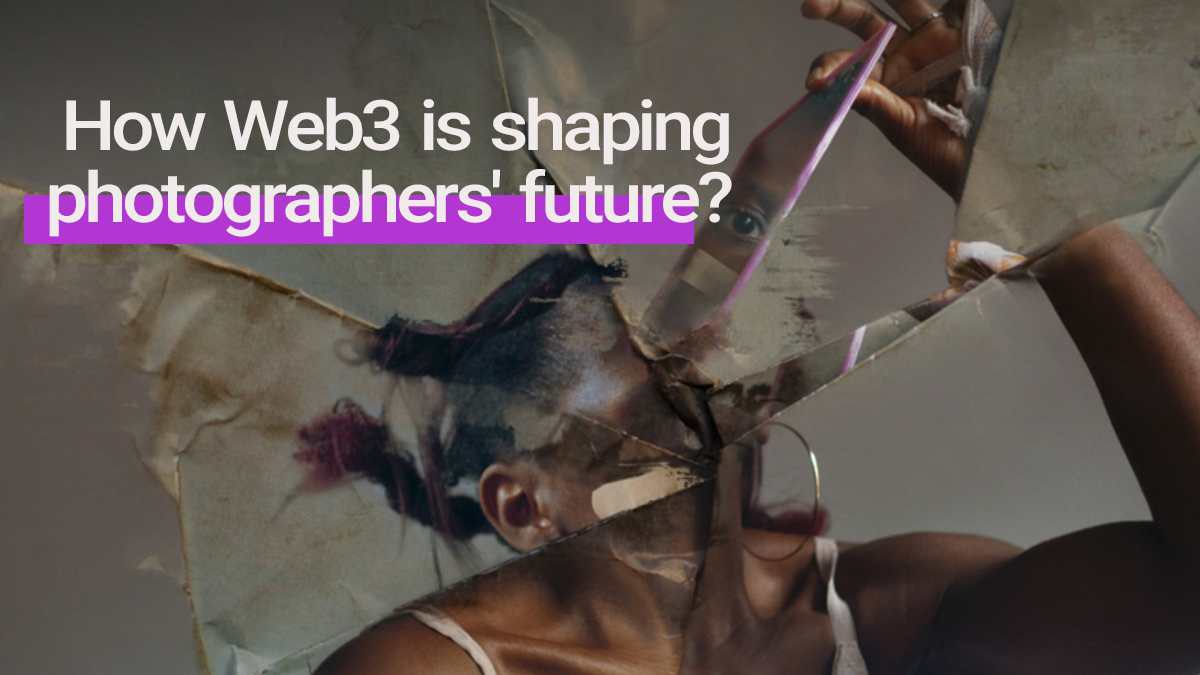
How Web3 is shaping photographers’ future? held by Soho House Paris
ReadFellowship is a photographer-led organization and online community. In this presentation, Fellowship co-founder Alejandro Cartagena talks with Holly Hay (Photography Wallpaper) and artist Priscilla Munkei Monnier about how Web3 and NFTs provide artists with intriguing ownership alternatives. This event took held at the Paris Photo Fair 2022 on November 10 from 7:30 to 9:00.Holly Hay, the event’s host, requested that Prisca Munkei Monnier, a Multidisciplinary Artist, Photographer, Film Maker, writer, and Performer, introduce herself and discuss how she became engaged.Through her intuitive gallerist acquaintance, Prisca Munkei Monnier was encouraged to complete the project. He felt it was fascinating that Priscilla was exploring this new medium. She feels that in the realm of NFT, all you have to do is create, do your thing, and put it out there to see how it’s received or sold or anything, which is, essentially, free when you make an NFT, so a lot of the art she sells is now being sent into NFT since it couldn’t be framed. She stated that many individuals were more concerned with, well, I’ll put that in my living room. I adore your work or where we’re going to place it, and you need to ask such concerns because space is crucial, but with NFT, you don’t need to worry about that.She believes you are more liberated in a digital environment. You need not consider physical obstacles. So you’re permitted to feel as though you’re permitted to love anything you didn’t anticipate, even yourself. Nobody sees you like anything. Additionally, there is this phenomenon of Oh, I like it. So, if that person enjoyed it, or I’m going to like it too, or whatever, it’s, you know, you discover it in digital space, but it’s the same thing in that it enables you to not just love what you love, but also afford the nerdiness in a financial sense. Because there is no impediment, nobody will ask, “Are you putting money into it, or are you simply looking at it?” Nobody will see you in your living room on your television screen.Holly believes that what Prisca mentioned indicates that the smart contract tied to an NFT becomes a very valuable aspect of it because it holds the copyright information regarding who owns the image. Who owned it previously? But its content may also include interesting information about what the image depicts. Therefore, you may saturate the smart contract with as much data as you desire. Who is in the photograph?Prisca continued, “it is” “as vital as being a photographer. Essentially, my foot ama photographs are under slave, i.e. the Queen’s and King’s, and it’s a pleasure to see them do their thing. And many individuals, even after a collector has purchased your photograph, continue to inquire about its meaning and your intent. And because it is digital, everything is viral, so it spreads quickly and retreats. And everyone understands what you intended to convey. Whereas, when you make your own show, maybe 10 people will be able to see you. Then one individual went home and said, “Oh, I went to witness that.” Priska produces extremely great work.”In the rest of the interview, Fellowship co-founder Alejandro Cartagena joined them. Alejandro uses photography and film to investigate identity, location, and the environment. His work has been widely displayed and is included in the collections of prominent worldwide museums. Mexican Alejandro Cartagena (born in Santo Domingo, Dominican Republic in 1977) resides and works in Monterrey, Mexico. A curator from the transfer called him two years ago to bring him in touch with someone at Foundation. He has been a photographer for around 17 years. This is one of the largest NFTs platforms. They remarked, “Hey, there’s this Foundation team that sells digital items.” Alejandro could not understand his meaning at the moment. And he has been publishing; he has self-published books and publishes on behalf of others. Therefore, he has always sought to improve the distribution of photography as art. “When I first heard the concept of a digital item or digital original, it looked like a terrific chance to sell a limited number of prints, perhaps 5 to 10. Consequently, the number of individuals you can reach is restricted, hence the term Limited Edition “explained Alejandro.Alejandro Cartagena Carpoolers NFT CollectionHe believes that with the NFT and the digital concept of a digital good, its global distribution will become enormous. Thus, he was drawn to the notion that he did not comprehend blockchains or anything else. He gave it a try. It did not work for him at all. It was initiated in October 2020. In the beginning, nothing occurred. A month later, when he returned, the website’s foundation was an improved version of what it is now. And he said, “Alright, that wasn’t for me.” Three months later, everybody was talking about NF T’s, and at the time, this was the case “I was using TikTok often. Again, I am attempting to establish communication with those that disseminate my work. And I thought, “Wow, I’ve heard of this before,” because they referenced foundation. I’m like, wait, I mean, these individuals with whom I was working.”In October 2020, there were five artists on Foundation, compared to about 50,000 now.At the beginning of the journey, digital animation was the most important item to develop and exhibit. They sold well, but photography was scarce. The Foundation Website suggested hanging three pieces. However, Alejandro felt inadequate. It took him four months to sell a single NFT, which is indicative of the market’s novelty. He believes that “often the biggest shock for a lot of artists with a distinguished history entering the NFT realm is that they’re like, hey, I’m here, pay attention.” It took him four months to locate a collector from Brazil, even though the majority of new crypto collectors have no knowledge of the art world and are attempting to educate themselves on what has occurred in the past. Alejandro had not followed the foundation’s instructions and had specified 50 pieces, but he had already purchased five pieces!This collector then introduced Alejandro to all of his friends, and he, the collector, essentially sold all of Alejandro’s artwork in five days after it had not sold for eight months. Because Alejandro sold all of his artwork, he remained in the NFT space. And all of a sudden, all of his work’s collectors reached out, desiring to have a conversation about what his work was about and what they were holding as a digital asset.What is a community in the world of NFTs?Prisca believes that being an artist is difficult to sell. So you get lucky and sell in five days in the NFT communities. “what you want to do is you back and you are able to do it because there’s a big huge community to choose from. And most of the time physically, you can’t do that. Because even if you want to help two artists well first you have to start going to see them in a division or maybe even know them or like they work you know, there’s just too many steps where you have a whole community all you have to do,” she stated.Alejandro believes that It’s just we’ve been building communities in the art world. I think we’ve never given it a name.” he believes Because they have lectures, presentations, and workshops, and they’re spreading the word that all of these things are community building activities. However, this simplification of a gathering place could be the metaverse, Twitter and discord. It has returned to the idea of community distribution, communication distribution, which has become so efficient that it is easier to think about a community in the other sense. You go, lecture, and give a presentation. You build a community, then leave. You can do the same here. But you’re still there digitally.According to Alejandro Cartagena, the universe of NFTs resembles social-economic systems. Fellowship is an open gallery; if you wish to develop a connection with the collector, that is OK. It is not like selling on the street corner. You could do whatever you desire. There is plenty of room for everything. Thus, this is the socioeconomic scenario. “I started talking to other collectors having meetings with them, people from Europe, from Africa, from all over the world or buying my work, and they you know, they first bought the NFT then they started buying books, some odd prints. And it was like, Oh, this is additive to my career,” Alejandro said.Alejandro believes that the issue is the diffusion of an artist’s identity. It gains effectiveness. Through a thesis, it is straightforward to locate a collector who may elect to purchase your work. They view the job and connect to the smart contract using a wallet. They obtain it. After asking inquiries, some collectors engage in social interaction, although the majority of the time they purchase the artwork on their own.To add a bit from his perspective as a promoter, these are the sorts of groups he believes artists and collectors are building. To stay in business, we must generate revenue. And “I was running another cow at the same time, that was running fellowship and it was all about Commissions about commissioning people to do new work. And we had one experience with Alessandra Sanguinetti. She’s a Magnum photographer, and we commissioned her to go to Argentina. And photograph a little town outside of website is and she messaged me, she went in December, she messaged me, and she’s like an account that I feel like I’m 16 years old. I’m doing whatever I want, with this money that you gave me to just do art. And that was I mean, for me, I’m like, she’s one of my inspirations as an artist and to hear that was really, really uplifting that there’s that possibility to fund creation with Liberty,” Alejandro saidHolly wanted Alejandro to explain the utility of the smart contract itself, as this is a vital component. We discuss NFTs, but what you actually pay for is the smart contract. Therefore, Alejandro responded that for a long time, photographers created their work through negatives, and it was owning the negatives that allowed you to create prints or books from those negatives. Currently, the analog negative has been replaced by a digital negative, which we refer to as a smart contract. A smart contract is a code that, in essence, signs for the artists on the blockchain, and whoever owns the smart contract also owns the negatives to where the royalties come from and where the work originates. Consequently, a smart contract has the potential to create a highly distinctive footprint on the internet. And it can be tracked. It is unchanging. And it really does what pictures on the internet don’t normally do, which is that they get on the internet and sometimes become bastardized and that they don’t have a father they don’t know who it belongs to because the internet is about circulation, but with the NFT coming from the blockchain, the source of who that artist is and what that work is about is revealed. Absolute power is associated with the beautiful item. Other additional use cases have not yet been investigated. But it’s a fantastic possibility for the development of a unified photographic industry and photography ecosystem. Create intelligent contracts You may mint your work on the smart contract, and the NFT can be lent out and recalled at any time. On fellowship, we are now constructing a similar smart contract.This possibility is comparable to signing a formal contract. And they responded, “No, no, we want it to exist on the blockchain and be enforced forever. “We don’t want to be having lawyers coming after you. No, no, let’s do a smart contract. Let’s inscribe on it all the mechanics that we want it how we want these images to be used. And if they can’t, if they’re not used, we have a key as Fellowship and they have a key as the estate and they can do the recall or like, cancel whatever is happening if they are not in accordance to so it’s all seamless. no necessity for a legal agreement. the smart contract does that.”What’s the legacy’s future?Alejandro his career as an archivist and later became a digital digitizer. He witnessed the processes of maintaining an archive and the difficulty of socializing an archive; the archive in which he worked contained 300,000 items, of which 100 could be circulated per year. If a researcher published the work or someone requested a single image for an exhibition that contained 299,000 images, those images are extinct. Nobody is aware of them. Therefore, the concept of digitizing archives and creating NFTs is incredibly intriguing. Because the result of creating the archives as NF Ts is that, like the unlock, you share ownership of the archives. You are suddenly a co-owner of an archive of 1,000 or 2,000 images. You have an interest because you own it. The purpose of museums’ educational programs is to excite the public about their archives and collections. And they spent thousands of dollars for five people to attend a lecture and ten people to attend the lecture.By offering ownership in this manner, the NFT will feel as though they own a portion of it. It has a different mechanism and a distinct sensation. “We did it with another project, we gave away 10,000 images of the photographer and it was 3400 collectors from around the world, our own that archive, and I cannot explain the excitement of the people when you know when they finally got their pieces and they’re researching who the people in the photographs are, where these places are people are going to the places to photograph how that looks today. I mean, that’s that’s what you know, a museum wants to activate people’s enthusiasm for the art. Yeah, absolutely,” he added.What is a community in the world of NFTs?Prisca believes that being an artist is difficult to sell. So you get lucky and sell in five days in the NFT communities. “what you want to do is you back and you can do it because there’s a big huge community to choose from. And most of the time physically, you can’t do that. Because even if you want to help two artists well first you have to start going to see them in a division or maybe even know them or like they work you know, there’s just too many steps where you have a whole community all you have to do,” she stated.Alejandro believes that It’s just we’ve been building communities in the art world. I think we’ve never given it a name.” he believes this Because they have lectures, presentations, and workshops, and they’re spreading the word that all of these things are community-building activities. However, this simplification of a gathering place could be the metaverse, Twitter, and discord. It has returned to the idea of community distribution, and communication distribution, which has become so efficient that it is easier to think about a community in the other sense. You go, lecture, and give a presentation. You build a community, then leave. You can do the same here. But you’re still there digitally.Latest NFT News, Trendings and Tutorials, right at your inbox, every Monday Leave this field empty if you're human: